From measurement to insight

How venues and associations collect conference-related emissions data
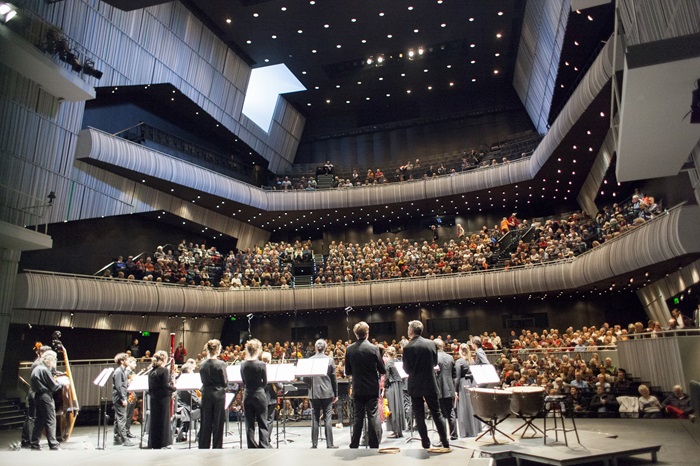
Orchestra on stage facing a packed concert hall audience, viewed from behind the musicians.
What remains after the final keynote of your conference has ended, the badges have been collected, and the conference room is empty again? New insights. New contacts. The start of a breakthrough in your field.

But something else remains too: a carbon footprint. And it is not necessarily found in the aspects participants can see, such as vegetarian catering, reusable cups or less printed material. The greatest impact lies elsewhere: in technical production, supplier logistics, mobility and material use.  

That climate impact can be substantial. Studies carried out by the Institute of Science and Technology Austria (ISTA) speak of up to five tonnes of CO₂ equivalent per participant for an overseas conference. If we want to reduce that enormous footprint, we first need to map it. Measuring is knowing, and therefore the first step towards informed decision-making.

A standardised measurement approach, signed Flanders

That is why Flanders Convention Bureau launched a carbon footprint measurement pilot project last autumn. The goal: to set up a standardised approach for measuring the carbon impact of conferences, by using tools such as "My Impact Tool". Three Flanders Heritage Venues joined the initiative: Concertgebouw in Bruges, Handelsbeurs in Antwerp and De Grote Post in Ostend. Together with conference organisers, these venues gathered relevant data and translated them into practical insights.

“Our ambition is to make impact measurement a practical reality for associations and PCOs, not an extra burden”, says Maarten De Brauwere. The Conference & Venue Expert at Flanders Convention Bureau points to a crucial nuance. “If impact measurement becomes an extra administrative layer, organisers will drop out. But if it leads to clear insights and better decisions, it becomes a tool that adds value.” 

Portrait of a smiling man with brown hair and light stubble, wearing a sweater over a striped collared shirt.

Maarten De Brauwere, Conference & Venue Expert at Flanders Convention Bureau 

Data quality is key

That added value depends on the quality of the data collected. This is also one of the biggest challenges. To produce meaningful insights, the data entered must be complete and accurate. High-quality data are the foundation for setting priorities and making feasible choices. For Jens Le Comte of Concertgebouw Brugge, this is the core question of the process: “how can a venue, together with organisers, caterers, suppliers and artists, collect high-quality data that can be interpreted correctly within the right context?”

Portrait of a man wearing glasses and a white T-shirt, standing against a gray concrete wall.

Jens Le Comte, Project Manager at Concertgebouw Brugge 

Jens’ colleague An Merlier, Coordinator Concertgebouw Events, emphasises the importance of good collaboration when collecting these data. “You cannot do this in isolation. The organiser needs data from the venue, while the venue needs information from suppliers such as the caterer, technical partner and transport partner. Alignment between all parties involved is therefore crucial. Every link in the chain makes choices that influence the final balance. Impact measurement makes that shared responsibility visible.” 

Head-and-shoulders portrait of a smiling blonde woman in a colorful blouse against a gray background.

An Merlier, Coordinator Concertgebouw Events 

The threshold for moving forward is lower than many organisers think

A step forward, not a higher threshold

The pilot project produced an important insight. The data that venues and their partners need to measure impact are abundantly available. In other words, the threshold for moving forward is lower than many organisers think. Measurement therefore acts as a crucial first step in opening conversations about sustainability. For Leni Pyra of De Grote Post in Ostend, carbon footprint measurement plays a key role in raising awareness among partners, clients and suppliers: “the measurement opens the conversation about where, as an event venue and as an organiser, you can truly make a difference.”  

Esther Rosé, Venue Manager at Handelsbeurs in Antwerp, highlights the user-friendliness of My Impact Tool, one of the carbon footprint measurement tools: “The concrete reporting and guidance make a big difference. Thanks to the tool’s clear structure, collecting the right data from clients and partners becomes much more efficient and easier to manage.”  

Smiling young woman with long blonde hair wearing a maroon shirt outdoors with green foliage behind

Leni Pyra, Team Lead at De Grote Post in Ostend 

Meanwhile, a second phase of the measurement study is under way, involving even more Flanders Heritage Venues, including BMCC, A Room with a ZOO, Het Predikheren, C-Mine, Constant Lier, Horta, Maison de la Poste and Schouwburg Kortrijk.  

This enthusiastic participation by the venues is a major advantage for international associations and PCOs. Organise your conference at one of these venues, and the tools are in place to calculate and report conference-related emissions. 

Portrait of a woman with shoulder-length red hair wearing a black shirt, standing in front of a light curtain.

Esther Rosé, Venue Manager at Handelsbeurs in Antwerp 

From measurement to insight

Carbon footprint measurement is increasingly being used within the meetings industry to collect data on the emissions associated with conferences and events.

Through the carbon footprint measurement project, venues and organisers gather information on topics such as participant travel, technical production, catering, accommodation and logistics. This information is combined into a report that provides an overview of the emission sources associated with each event.

The resulting data can be used by organisers and venues to compare events, identify the main sources of emissions and evaluate future event formats and operational choices.

Two people walking past a modern brick-and-glass building with vertical slats under a cloudy sky.

Concertgebouw in Bruges 

Want to know more about measuring your conferences' carbon footprint?

Contact Maarten De Brauwere 

Your contact person

Free inspiration for your next conference

A successful conference is one that inspires. That’s why we offer you here tons of inspiration. For a conference in your domain, for your conference in Flanders.